Asking for adjustments, explaining needs, making choices and setting boundaries can become part of childhood when other people do not automatically understand what you need.

Children with a disability can begin developing advocacy skills long before we think of them as self-advocates.
Advocacy Begins When Children Are Asked
Children cannot learn that their opinion matters if nobody asks what they think.
When I was around eight or nine, my parents were considering taking the hospital where I was born to court.
They asked me what I thought.
I remember asking them one question:
Would it make me better?
They told me no.
So I said I didn’t want them to do it.
I was a child. I wasn’t being asked to understand the legal system or carry responsibility for an adult legal decision.
But I understood what mattered to me.
I wanted to know whether taking that action would change my disability.
Once I knew it wouldn’t, I had an opinion about whether I wanted my family to pursue it.
There is an important distinction here.
Listening to children does not mean expecting them to make complex adult decisions alone.
Adults still have responsibilities. They may understand consequences, risks and information that a child cannot fully understand yet.
But that does not make the child’s perspective irrelevant.
Self-advocacy can begin before a child knows the language of advocacy.
It can begin with adults asking:
What do you think?
What matters to you?
How do you feel about this?
And then showing through their response that the answer matters.
Before children learn to use their voice, they need experiences that show them their voice is worth hearing.

When a child says agreed support isn’t being provided, how adults respond can shape whether they feel safe speaking up again.
Knowing What You Want Even When Adults See the Risks
Self-advocacy can also mean knowing what you want when other people can see reasons why it might be difficult.
When my family was choosing my high school, I knew which school I wanted to attend.
I was moving from a support setting into mainstream high school.
I knew it was going to be a significant transition.
People told me it would be hard.
But I didn’t change my decision.
I still wanted to go.
Sometimes supporting a child’s voice means allowing room for a choice that adults know may involve challenges.
That does not mean withholding information or pretending the risks do not exist.
Children need honest information.
They may need guidance.
They may need considerably more support to make their preferred option possible.
But there is a difference between saying:
This might be difficult. Let’s think about what you will need.
and:
This might be difficult, so perhaps you shouldn’t do it.
For children with a disability, difficulty can too easily become a reason to narrow choices before they have had the opportunity to try.
Learning to advocate for yourself can include learning to say:
I understand that this might be hard. I still want the opportunity.
Being warned that something may be difficult should not automatically take the choice away.
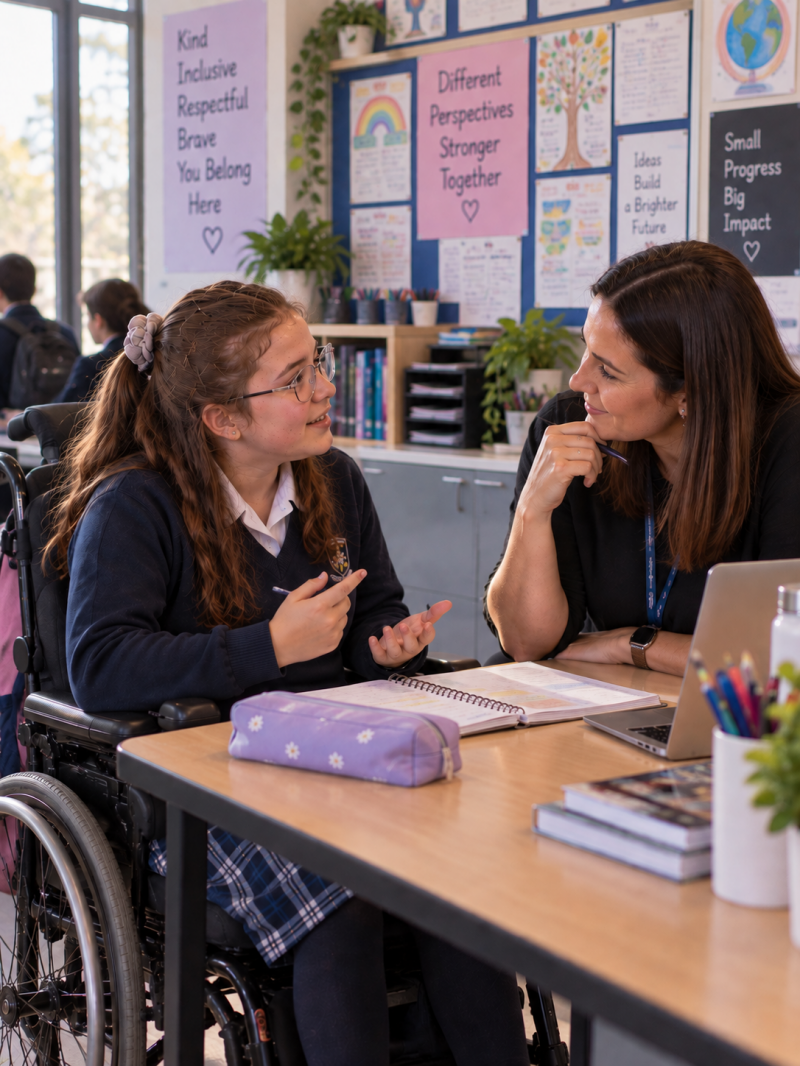
Learning to explain what you need can build autonomy. Having to continually prove why you need it creates another responsibility.
Advocacy Also Means Setting Boundaries
For children with a disability, self-advocacy is not only about learning when to say yes, I need help.
It is also learning when to say:
No.
Not like that.
I don’t want to talk about this.
I don’t want that person involved.
Please don’t share that.
In high school, there was a girl in my friendship group who was leaving me out of social outings.
I was upset about it and confided in my teacher aide.
Later, another teacher brought the situation up in front of me.
That was how I discovered that something I had shared about my personal life was being discussed with other teachers.
I had to tell my teacher aide that I didn’t want my personal life discussed with other people.
This was someone who supported me at school.
But needing her support did not mean that everything I told her needed to become information for other adults.
Children with a disability can have many adults involved in their lives. Teachers, aides, therapists, support workers and health professionals may genuinely need to share some information to provide appropriate support.
That makes respecting boundaries even more important.
Adults having access to a child’s life does not mean every detail of that life is automatically theirs to share.
Children can be taught that they are allowed to ask questions about who knows something, why they need to know it and whether information needs to be shared.
They can also be given opportunities to say when a boundary has been crossed.
Needing an adult’s support does not give that adult unlimited access to a child’s private life.
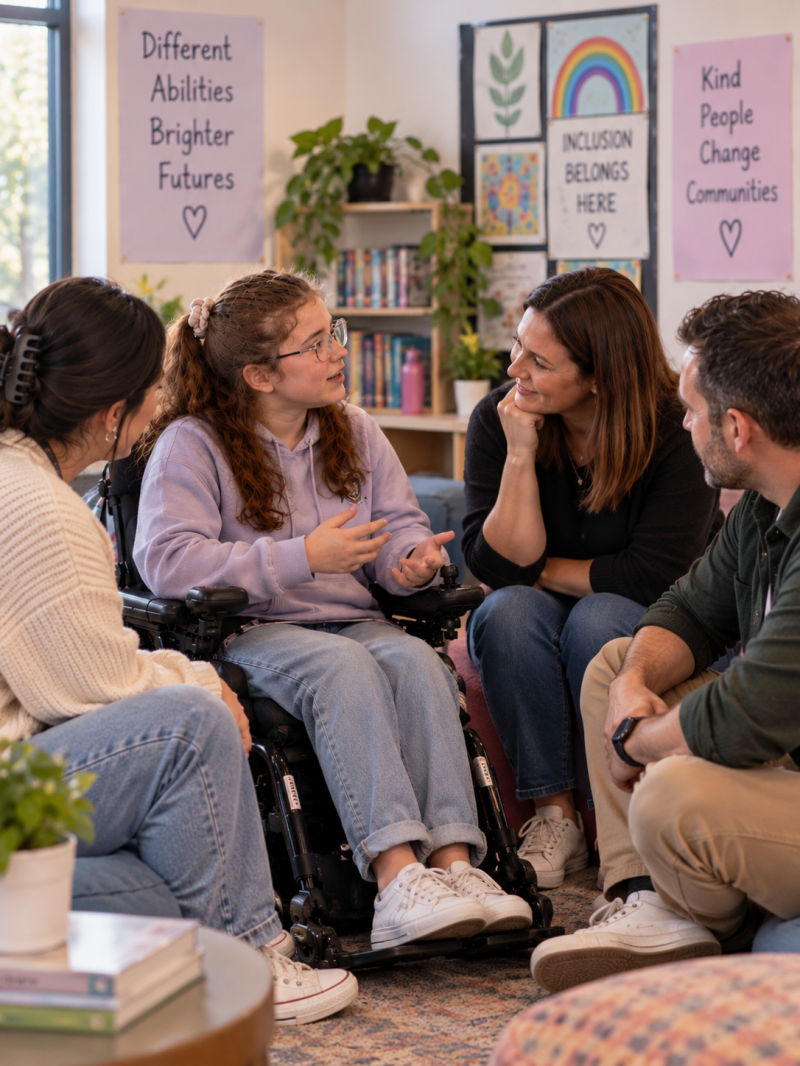
The goal is not simply to teach children to speak up. We also need environments that respond when they do.
A Reflection for Parents, Educators and Support Providers
When a child with a disability becomes good at speaking up for themselves, it can be easy to see that as a sign of confidence.
And sometimes it is.
But it can also be worth asking what gave them so much practice.
Perhaps they have learned to remind adults when an adjustment has been forgotten.
Perhaps they have learned to explain why they need help.
Perhaps they know how to correct assumptions about what they can manage.
Perhaps they have learned to say when support feels uncomfortable or when something personal has been shared too widely.
Those are important advocacy skills.
But the child should not always have to be the person who notices what is missing.
When a child tells us something isn’t working, the next question does not always need to be:
How can we teach them to advocate more effectively?
Sometimes it needs to be:
What are they already telling us—and what can the adults around them do differently?
We can notice whether a child has to ask repeatedly before something changes.
We can pay attention when their words become frustration, tears, withdrawal or reluctance to ask again.
We can make room for them to disagree with an adult without treating disagreement as a lack of understanding.
We can ask their opinion before decisions are made rather than waiting for them to challenge the decision afterwards.
And we can respect a child’s boundaries around their personal information, even when adults are closely involved in providing support.
Not every child will confidently say:
This isn’t working for me.
Some children may communicate that through behaviour.
Some may need more time.
Some may need someone they trust to help them explain.
And some may not yet know that they are allowed to disagree.
That makes the environment around the child just as important as the advocacy skills we teach them.
This is also why I created Is the Child Being Heard?, a reflection resource for parents, educators and support providers. It helps adults look at what a child is repeatedly having to advocate for, whether their voice is actually changing what happens next, and what responsibility the adults or environment could take back.
Because supporting self-advocacy is not only about teaching children what to say.
It is also about becoming the kind of adults who notice, listen and respond when they say it.
Self-advocacy should give a child more power within their support—not make them responsible for securing it.
Advocacy Can Begin Earlier Than We Realise
Self-advocacy is often discussed as something children with a disability need to learn.
They may need to explain what support works for them.
Ask for an adjustment.
Correct an assumption.
Say when something is uncomfortable.
Make choices about their own lives.
Set boundaries around support and privacy.
These are valuable skills. As children grow, being able to communicate what they want and need can give them greater control over decisions that affect them.
But children with a disability can begin developing these skills remarkably early.
Sometimes that happens because adults deliberately create opportunities for their voice to matter.
Other times, it happens because something isn’t working and the child realises they need to speak up.
There is an important difference between the two.
Children should gradually learn how to advocate for themselves.
But learning to have a voice should not mean becoming responsible for making adults listen.
Self-advocacy should increase a child’s influence over their life—not transfer adult responsibility onto them.
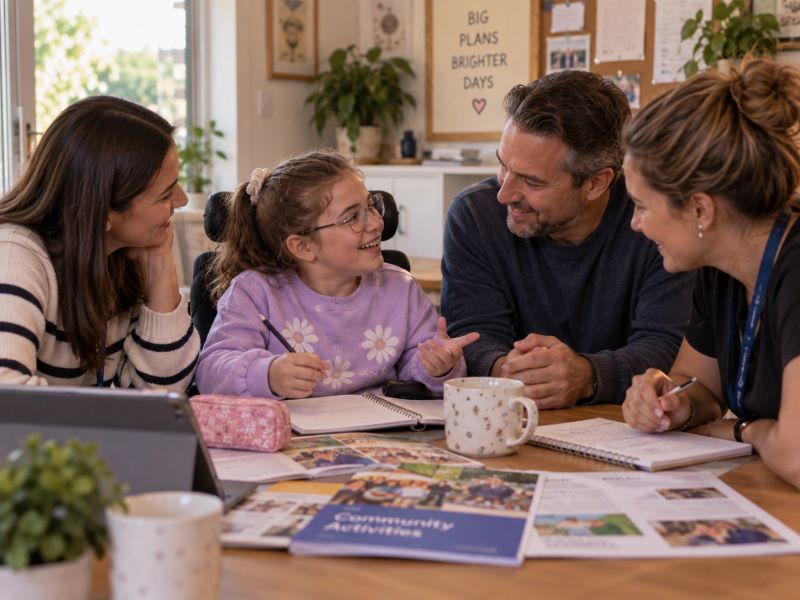
A child’s voice can matter in a decision even when adults still carry the responsibility for making it.
Recognising When Something Isn’t Right
Advocacy is not always about requesting something new.
Sometimes it means recognising that something which was already agreed upon isn’t happening.
When I had my first period, there was a procedure that was supposed to be followed at school.
If the bleeding became heavy, staff were meant to contact my mum.
It did become heavy.
Mum wasn’t contacted.
I knew what was supposed to happen, so I reminded the staff.
I was dismissed.
Eventually, I became emotional.
But becoming upset didn’t mean I didn’t understand what was happening.
I knew there was a plan.
I knew the plan wasn’t being followed.
And I knew something wasn’t right.
Children with a disability can find themselves in similar situations with support plans, adjustments, personal care, medication, communication or accessibility.
We often talk about teaching children to speak up.
But we also need to think about what happens after they do.
If a child repeatedly has to remind adults about agreed support, advocacy can start becoming another responsibility the child carries.
And if they become frustrated, distressed or emotional while trying to communicate the problem, their emotional response should not become a reason to dismiss the message underneath it.
A child should not have to communicate a concern perfectly before adults take it seriously.
Children do not have to explain a problem perfectly for the problem to be real.

A child can understand that something may be difficult and still want the opportunity to try.
Learning to Explain What You Need
As children with a disability grow, they can become increasingly aware that other people do not automatically know what works for them.
They may learn to explain:
I need more time.
I need help with this part.
I can do this part myself.
I need instructions presented differently.
I need a break.
That support isn’t working for me.
Please ask before helping me.
These are important skills.
Knowing your own needs can create greater autonomy, particularly as more teachers, support workers, health professionals and other adults become involved in your life.
But there can also be a hidden expectation underneath this.
The child can become the person responsible for filling every gap in everyone else’s understanding.
They may be expected to repeatedly explain the same need to different adults.
They may have to correct assumptions when someone mistakes what they can do once for what they can manage consistently.
They may need to notice that an adjustment has disappeared and ask for it again.
Developing the ability to do those things is valuable.
Needing to do them constantly is something different.
Children should have opportunities to understand and communicate their needs without being made responsible for educating every adult around them.
Knowing how to ask for support should not mean having to continually prove why the support is needed.
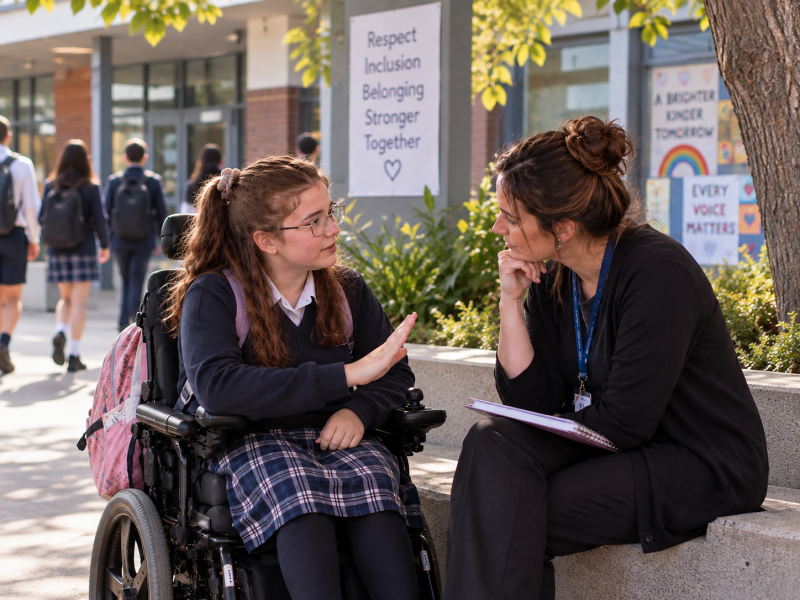
Self-advocacy is not only knowing when to ask for help. It is also knowing when you are allowed to say, “Please don’t share that”.
When Children Become Responsible for Making Adults Listen
There is a lot to value in self-advocacy.
A child who gradually understands their needs, preferences and boundaries can carry those skills into adolescence and adulthood.
But we need to be careful about what we celebrate.
A child who becomes exceptionally good at explaining their disability may have had a lot of practice because people repeatedly misunderstood it.
A child who knows exactly how to remind adults about their adjustments may have learned that support sometimes disappears unless they notice.
A child with strong boundaries may have developed them after discovering that other people would not always recognise those boundaries automatically.
And not every child will be able to advocate in the same way.
Some children communicate differently.
Some freeze when challenged.
Some become emotional.
Some need time to understand what happened before they can explain it.
Some may know that something feels wrong without having the words to identify why.
Others may assume that because an adult made a decision, the adult must be right.
Their needs do not matter less because another child can articulate theirs more confidently.
A child’s ability to advocate should never become the test they have to pass before adults provide appropriate support, listen to discomfort or respect a boundary.
A child’s needs should not become more valid simply because they can explain them well.

I learned different ways to advocate for myself as I grew. But knowing how to use my voice should never have meant carrying the whole responsibility for being heard.
Add comment
Comments